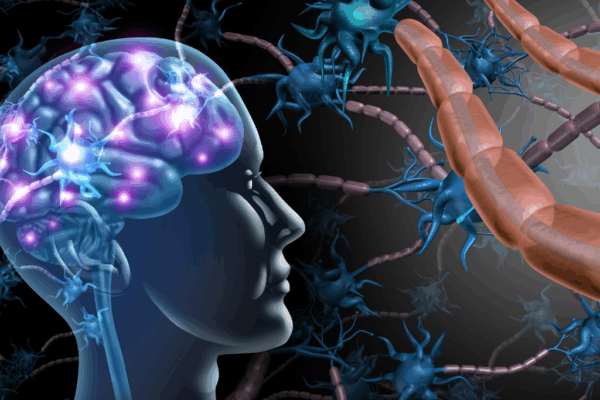
It is known that the human body is the most sophisticated living system, but arguably the most intricate of them all is the human brain. The brain is the control system of the body, allowing us to think, feel, move, remember, and interact with the universe around us.

While diving into studying the work of the brain in detail is a field in its own right, it is easy to understand the basic functioning of the brain without studying neuroscience. Put simply, the brain processes information by receiving, interpreting, saving, and responding to stimuli. The purpose of the present article is to elaborate on the daily functions of the brain to demonstrate the importance of the integrated and thoughtful functioning of the body through the stimuli transformed into actions and thought processes.
How Neurons Act as the Brain’s Communication Network
Neurons are specialized brain cells. Like every living system in the body, the brain is composed of billions of specialized cells called neurons. Neurons are cells that serve a specialized purpose. Like miniature communication units, each of them can send and receive electrical messages. These messages travel down long extensions, called axons, and cross junctions, known as synapses. Synapses serve as connectors in a massive networking system. This networking system enables quick brain communication.
It may be useful to think of neurons as people exchanging messages in a stadium filled with spectators. Everyone can send a message to several other people, who can then send messages to other people. Information can propagate throughout the entire stadium in a matter of seconds. Your brain, however, does this with much greater speed and through a more complex architecture.
Neurons come in all forms, and they serve a variety of purposes. Some neurons are sensory and can pick up on stimuli in the environment, such as light, sound, or touch. Others are motor neurons responsible for muscle control. Other neurons can carry out functions such as higher thinking, reasoning, or memory. While any one neuron may be simple in structure and function, together, they are responsible for producing the complex outputs we describe as intelligence or consciousness.
How Thoughts and Actions are Generated: The Role of Electrical Signals
Neurons transmit messages through the emissions of small electrical signals, known as action potentials. An action potential is a small surge of electricity that runs down one neuron. It can be compared to a wave moving down a row of people in the stadium. Each section of that row stands up for a short period of time before sitting down to allow the wave to pass through.
Fast transmission is possible through the electrical activity dissipation within the brain. Action potentials constitute a binary phenomenon; they can either be fully discharged or remain completely inactive. The intensity of neural signals is relative to the number of active neurons and the rate at which they fire. Such activations form information patterns to which the brain responds appropriately.

When a neuron’s electrical signal reaches the terminal end of the axon, it causes the release of neurotransmitters. These chemicals migrate and activate the downstream postsynaptic neuron across the synapse. While some neurotransmitters provide facilitatory signals, others are inhibitory. The ratio of excitatory to inhibitory signals determines the constellation of the brain’s reactions to any given stimulus.
How the Brain Receives Information from the Senses
The brain relies on one of the senses to learn about the world, which is a primary source of information. The building block of each sense—sight, hearing, touch, taste, and smell—is its own unique information. Sensory organs transduce and encode physical stimuli into electrical signals that are free of ambiguity.
As an illustration, light-sensitive cells reside in your eyes. When light strikes the eye, it initiates a chemical reaction that results in an electrical signal. This signal is sent to the brain’s visual cortex, where it is processed. Sounds are converted to electrical signals in your ears and sent to the brain’s auditory cortex. Your skin has receptors that can detect pressure, temperature, and pain.
Every sense has its own designated path to the brain. The brain then combines these different types of information and forms a singular perception of the environment. For example, if you see and hear a dog that is barking, your brain combines that sound with the visuals of the dog and perceives it as one event. This is done so effortlessly that you are probably unaware of it.
The Way the Brain Structures Data
The brain is not mechanical with the information it receives. The brain structures signals into a hierarchy and different patterns. This is done so that the brain can quickly and efficiently recognize an object, comprehend the structure of a language, and make decisions. One of the brain’s best abilities is to recognize patterns.
The area of the brain called the hippocampus is crucial for organizing information and memories. It sorts the information the brain receives to figure out what is needed for short- and long-term memories. Whenever something new is learned, the hippocampus works with other brain structures to form and stabilize the memory. This is where sleep comes in, as it is especially vital for the memory consolidation process. Neural connections formed through learning are more firmly established during sleep.
The brain’s cortex, which is the brain’s outer covering, is split into sections with designated roles to play in the processing of information. The frontal lobe is used for planning and making decisions. The parietal lobe is in charge of processing spatial information, and the temporal lobe is used for dialect and recognition, while vision is the domain of the occipital lobe. These areas of the brain collaborate as networks of regions that create intercommunication systems to form pathways through the brain.
How Learning Changes the Brain Through Plasticity
The process of learning is directly correlated with the brain’s ability to change. The brain’s ability to make these shifts is called neuroplasticity. When an individual practices something, studies new material, or creates a new habit, the brain creates and strengthens specific connections between the neurons. Doing so lowers the level of effort needed by the brain to execute the same pattern of activity in the future.
Walking on a grassy field can help illustrate this point further. The first time you walk on a field with tall grass, you will leave a trail. If you keep walking on the same field, the grass on the path will become flattened. This is the same with grass and with neural connections. The same path flattened grass, and the repeated activity will strengthen specific neural pathways.
Flexibility can also explain how our brains adapt after an injury. If one region of the brain is damaged, other regions can compensate for the loss. This is especially true for children. This flexibility is the reason we can pick up new languages, new skills, and other activities later on in life.
How the Brain Makes Decisions and Forms Reactions
Making a decision requires a person to analyze the situation and choose a course of action. A person will need to use their attention, memory, emotion, and reasoning in the process. Weighing the pros and cons and predicting a certain outcome is the common job for the frontal lobe of the brain. However, there are other parts of the brain, like the amygdala, that help with feelings. The amygdala can help a person feel if a situation is safe or if it has some element of risk in it.
When making a choice, the mind draws from the multitude of data provided by the senses, the mind’s experience, and the mind’s future expectations and scenarios. Then it lines up the choices and contrasts them. One of the choices is always conscious, which is the choosing of, say, what to have for lunch. Another choice is always unconscious, like slamming down a hand that has been placed too close to the bottom of a very hot frying pan.
Reactions can be voluntary or involuntary. As the names suggest, voluntary reactions require some degree of control and thought, while involuntary ones can be thought of as the reflexes or the instant actions that are directed by the spinal cord and the brain stem. These are designed to allow a person to avoid instant danger by removing any conscious thought from the actions that are excessive and therefore slow to danger. The mixture of slow thought and instant control is designed for maximum safety and efficiency.
Why the Brain Is Always Active
Even when you are sitting down or sleeping, the brain is always active. It is at the most basic level of control and function, ensuring that the most basic and essential processes, such as breathing and heart rate regulation, are controlled and managed. There is also hormonal control that the brain manages, as well as the organizing of information and directing of waste through the glymphatic system. In deep sleep, the brain is especially effective in removing the waste that has been created through the running of the system and the waste proteins that have been allowed to accumulate throughout the day.

Internal activity is also created from imagination, problem solving, memory, and daydreams, and the activities that are mental processes that surround the day that has been experienced, as well as the day that is to be experienced. The active mind also builds and reinforces neuron connections, especially when the person is planning for the future.
This constant activity requires energy. The brain uses about twenty percent of the body’s energy, even though it makes up only a small portion of body weight. This energy supports the billions of electrical signals firing every second.