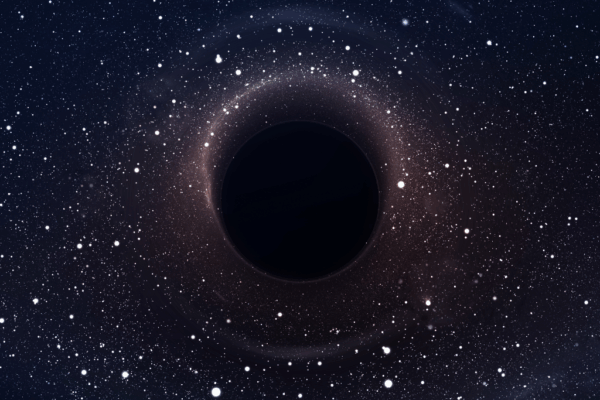
The first step in identifying what is and what is not a black hole is to understand the actual definition of a black hole. As understood from the context, black holes are normally assumed to be regions of the universe with intense gravitational pull, in which nothing, not even light, can escape.

Nothing can be understood about black holes without defining what the size of a region is. The universe is nigh-infinite in size. Therefore, there can be infinite regions in the universe with the pull of a black hole.
What Exactly Is a Black Hole
A black hole is a region of space where gravity is so strong that nothing can escape it, not even light. Gravity exists everywhere, but it becomes extreme when a large amount of matter is squeezed into a very small area. When this happens, the fabric of space and time bends sharply inward.
Singularities are points at which scientists believe all matter within a black hole is compressed into a point of infinite density. The black hole’s event horizon is a boundary that no information can cross, so nothing that goes into a black hole can come out.
Black holes are nothing. A black hole is still a massive object, just like stars and planets. If, for example, our Sun were a black hole that was the same mass, the Earth would continue to orbit it. The danger is only if you get close to the black hole.
The Formation of Black Holes
When massive stars are at the end of their life cycle, they usually form a black hole. During their life cycle, they are constantly fending off the pull of the star’s own gravity with the energy that comes from nuclear reactions. When a star runs out of fuel, the energy or outward push dissipates.
A collapse can lead smaller stars to form a white dwarf or neutron star. In the case of larger stars, however, gravity is completely victorious. The core of the large star collapses under its own weight, compressing matter we cannot even begin to understand. This is often accompanied by a supernova explosion of the outer layers, leaving a black hole core behind.
There are also the supermassive black holes that are at the center of most galaxies. These gobbles contain millions, and even billions, of solar masses. How they are formed remains an open question. Perhaps they formed from the merger of smaller black holes, or they formed quickly in the early universe.
The Event Horizon and Why it Matters
The event horizon is often described as the ‘point of no return,’ as to an outsider, it appears as a dark sphere in which light disappears and the infalling object can no longer be seen. However, from the perspective of the infalling observer, the experience would be completely different.

Due to Einstein’s theory of relativity, as one approaches the event horizon, time appears to slow down for faraway observers, and the light becomes redder and fainter until the infalling object fades completely from view. This is due to the intense gravity at the event horizon.
When someone hears about the event horizon of a black hole, they may think about the surface of a black hole and a solid structure that may be dangerous. However, the event horizon is not a physical structure that one would drive into. It is not a concrete wall, and there is no explosive boundary. The dangers are inside black holes, where the tidal forces of the black hole stretch and compress in extreme ways.
What Happens If You Fall Into One
Entering a black hole is not something anyone would plan to do, but scientists try to understand what is going to happen when an object is pulled into a black hole. The closer you get to a black hole, you start to experience something called a gravitational gradient. This means that the gravitational forces are different at your feet than at your head. This would create a stretch on your body that people commonly refer to as `spaghettification.`
When black holes are relatively small, this stretch would happen before you reach the event horizon. When black holes are really large, at first, it would appear that there is not enough event horizon to be dangerous to you. However, there would still be a time when the tidal forces would be too extreme, and there is no material that can withstand them. These occurrences are unknown to science since our current understandings break down there.
How Scientists Detect Invisible Objects
Black holes are hard to study. They cannot be viewed directly, as they do not emit light. Scientists need to study their effects on nearby matter, such as stars. One method of effect studies involves considering what sort of unseen object could cause a star to be pulled and moved like it were orbiting a black hole.
Another method involves studying the gas and dust that falls toward an invisible black hole. Before crossing the event horizon of the black hole, the gas and dust heat up and glow brightly. Some black holes are known to produce and emit powerful jets of particles that can also be detected from large distances.
Imagery of black holes has recently been captured based on the shadows that they cast of black holes. Though the objects are not directly observed, the evidence provided in the pictures is strong to support the claims that black holes do exist as predicted.
Do Black Holes Last Forever
Black holes were previously thought to be completely permanent. Then physicist Stephen Hawking suggested that black holes can slowly lose mass. The process is known as Hawking radiation and is caused by quantum effects that occur at the event horizon.
The completion of the process takes an extremely long time for the majority of the big black holes. Even supermassive black holes will take an unfathomable amount of time. Complete evaporation will take longer than the current estimated lifespan of the universe for a black hole that is the mass of our Sun.
Hawking radiation has yet to be empirically observed, yet it is an amazing phenomenon, for the suggestive theories that black holes are not permanent offenders. Instead, their constructs are changing on long time scales that are beyond human comprehension.
Why They Matter to Us, Personally
Overall, black holes appear to be a distant concept and not a very practical aspect of our daily lives. They influence the formation and evolution of modern galaxies; supermassive black holes are the most fundamental part of changing the star formation process and the vast ranges of space around them.

Black holes exist on the connective barriers of how we understand time, gravity, and the quantum theory of our reality. Understanding black holes is to understand the fundamental operating principles of existence; it is to achieve the most for our conceptual apparatus.
Black holes remind us deeply of the beauty that lies within the universe. They challenge our perception of the order and structure of the universe for the better. They fill the empty spaces with order and concepts with structure, and they challenge us to keep things in the most organized and clean manner.